

The chapter grew from an unexpected connection between Dr. Paula Seymour, associate professor of social entrepreneurship and coordinator of Flagler's Social Entrepreneurship Program, and Michael Bracken, chair of the Earth Charter International Board and president of Medcom Benefit Solutions. Bracken introduced Seymour to the Earth Charter and its leadership certification programs, an opportunity that immediately aligned with Seymour's approach to teaching and the mission of social entrepreneurship.
Launched in 2000, the Earth Charter is organized around four pillars: respect and care for the community of life, ecological integrity, social and economic justice, and democracy, nonviolence, and peace. The Charter provides an ethical framework for building a more just, peaceful, and sustainable world and encourages people to consider how they can contribute to the well-being of their communities and the planet.
For Seymour, the connection to Flagler was immediate.
"I looked at our core values and then looked at the four core pillars of the Earth Charter, and I was like, wow, this is really in alignment," Seymour said.
That alignment initially led Seymour to introduce the Earth Charter's youth leadership certification to her students. Cameron Groome and Ethan Sacks, both Social Entrepreneurship students and leaders within Flagler's Enactus program, embraced the opportunity.
As Seymour learned more about the organization, she asked whether the Earth Charter had campus chapters at colleges and universities around the world.
The answer was no.
"That was a total shock to me," Seymour said. "Here's an organization that students have been a huge part of. Why don't we have a campus chapter where the students can actually put these pillars into action at their schools?"
Groome and Sacks took the idea and ran with it, presenting the initiative to the Student Government Association, which approved the organization last semester. The students also completed the Earth Charter's youth leadership certification and represented Flagler at the Earth Charter Youth Summit at Soka University of America in California, where they connected with other young leaders from around the world.
Sacks and Groome's leadership at the summit extended beyond simply participating in the sessions. Sacks was selected to lead a plenary session on ethical leadership, courage, resilience, and hope, placing him alongside young leaders from around the world shaping conversations on ethics, sustainability, and global citizenship. Flagler is now listed as an official partner organization for the summit, a distinction tied directly to the College's role in co-founding the world's first Earth Charter Campus Chapter.
Groome took on a leadership role of her own, serving as co-moderator for a session on "Sustainability & the EC in Educational Settings." She guided conversation across four presentations from student leaders around the world, including talks on systems thinking and sustainable change in schools, youth leadership and cooperation in Quintana Roo, Mexico, sustainability integration at the Claremont Colleges, and student agency in university sustainability efforts. The role placed her at the center of an international exchange, facilitatingdialogue among presenters from China, Mexico, and the United States.
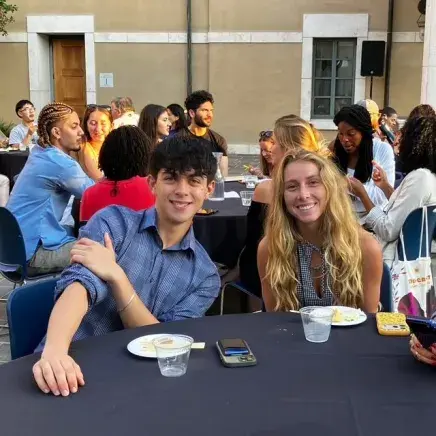
For Seymour, those experiences provided an early glimpse of what the chapter could offer Flagler students: opportunities to take the principles of the Earth Charter and explore how they can be put into practice at Flagler and in the broader community.
"The Earth Charter gives us an opportunity to take these principles and put them into practice," Seymour said. "Let's do things where we're actually building inclusive and respectful communities."
Seymour sees that work as inherently interdisciplinary. Rather than limiting the chapter to Social Entrepreneurship or the School of Business, she hopes students from areas such as coastal environmental science, anthropology, political science, and other disciplines will bring their perspectives to the same challenges.
"Business students did the work to get this chapter started," Seymour said. "But this isn't about one discipline owning it. It's about bringing people together, at the youth summit, on our campus, wherever the work happens, because that's where real change comes from."
The chapter's first year will be an opportunity for students to determine what that interdisciplinary work looks like in practice. Seymour hopes students will begin connecting across academic disciplines while developing relationships with businesses and other universities that support the Earth Charter's mission. Those connections could give students work or internship opportunities, develop professional relationships, and explore how their future careers can contribute to positive change.
The chapter also has a distinct global component. After connecting with students and Earth Charter leaders from around the world at the Youth Summit, Seymour hopes Flagler can eventually bring members of that international community to campus.
"We're the first in the world to start an Earth Charter campus chapter," Seymour said. "But we didn't get here alone. We're building upon relationships with young leaders around the world, and I want that to keep shaping what this chapter becomes."
The initiative's origins connect to the Hazel Henderson Center for Social Entrepreneurship, which helped create relationships that opened the door to Earth Charter International. Seymour previously brought students to Henderson's home to learn from her wisdom directly.
Henderson, whose ideas centered on rethinking traditional approaches to economics and creating systems that better serve people and the planet, envisioned her house being used for many purposes, among them, as a place for social entrepreneurship students and future leaders to continue her work.
Now, that connection is helping create a new opportunity for Flagler students.
Students interested in getting involved this fall will have the opportunity to help shape the chapter during its inaugural year. With no existing campus model to follow, members will help determine how the organization operates, what projects it pursues, how students from different disciplines work together, and how Flagler connects with the growing international Earth Charter community.