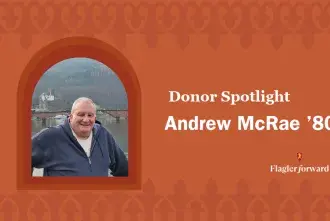
“I was – and still am – interested in all branches of science,” Soronen said. “I started reading Scientific American when I was about 12 years old. Anything from astronomy to zoology is interesting to me.”
That early experience sparked a journey that eventually led Soronen to a career in radiation oncology. He said the work provided daily satisfaction through the opportunity to help people who needed his knowledge and expertise in an ever-evolving scientific field. When he retired in 2008, he moved from Tacoma, Washington, to St. Augustine to be closer to his daughter.
“I love the small-town feel of St. Augustine, and I believe a college or university improves the quality of life in a community,” he said.
After settling in St. Augustine, Soronen’s growing circle of friendships connected him to Flagler College. Donors, staff, and faculty he befriended encouraged him to become more involved in the Flagler community. Around 2015, he was introduced to Nicole Pece, director of development in the College’s Office of Institutional Advancement, and it didn’t take long for the two to strike up a conversation about the relatively new Coastal Environmental Science program.
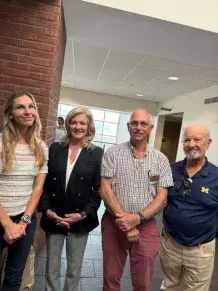
Pece shared the College’s strategic plan for expanding its science programs.
“I saw an opportunity where I could help shape the science program for the future benefit of students and faculty. I had to know more,” Soronen said. “So, when the College started an inaugural Science Advisory Board [SAB], I immediately became a member.”
Now a longtime SAB member and its immediate past vice chair, Soronen hopes the College will continue expanding opportunities for hands-on research for both students and faculty, allowing more people to develop a meaningful connection to science. He envisions Flagler’s science program making far-reaching contributions to humankind and the environment, while positively impacting the local community.
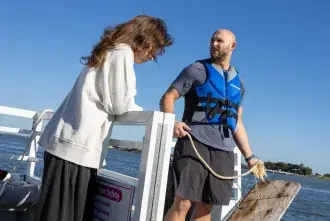
“An example would be finding out what is happening in our local waterways, like determining what kind of pollution there might be, and identifying ways that we can enhance and improve them,” Soronen said. “It generates useful information and helps faculty stay abreast of their research at the same time.”
Through his involvement with the SAB, Soronen has consistently advocated for making the expansion of the sciences an essential educational priority at Flagler. Beyond his volunteer service, he and his wife, Joan, regularly support Science Week and the Science Fund for Excellence. He has also made a major contribution toward the construction of the new Modular Science Laboratory.
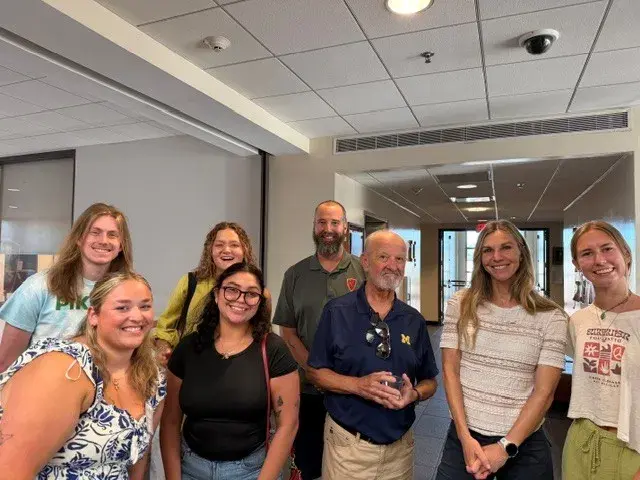
“The key to elevating Flagler’s prestige and reputation is to ensure that necessary resources are in place for faculty and students to continually develop their educational goals and research interests,” Soronen said. “To be competitive, Flagler truly needs to support a curriculum in basic chemistry, organic chemistry, and physics for two main reasons: it will recruit more students, and it will broaden career opportunities for them in biomedicine, healthcare, biology, and environmental science.”
Meeting these needs will require significant investment. Science programs depend on specialized equipment and safety gear, underscoring the need for additional funding as the College looks toward a permanent Science Academic Building.
"It takes big bucks, yet I view this as a community responsibility,” Soronen said. “Although I plan to continue donating to the College by leveraging my required minimum distributions, I want to raise broader awareness about Flagler’s science program so that others will consider doing so as well. We need to support those who are dedicated to creating a healthier and more sustainable future for us and our world."