

Dr. Bharat Bhattarai is a native of Nepal and earned his PhD in Chemistry and Molecular Cell Biology from Inha University in South Korea. Following several years of postdoctoral research at the University of Manitoba and the University of Connecticut, he transitioned into academia.
Dr. Bhattarai brings over 20 years of experience in undergraduate teaching and research. Before joining the faculty at Flagler College in Fall 2025, he served as an Associate Professor of Chemistry at Waldorf University in Forest City, Iowa. His research expertise lies in the design, synthesis, and optimization of small organic molecules, specifically targeting the development of therapeutic treatments for diabetes, obesity, and various cancers.
Q: What/who inspired you to pursue your field of study?
A: My passion for chemistry was sparked early on by the influence of my uncle and a cousin, both of whom were chemistry professors and served as my primary mentors. Although I initially aspired to become a medical doctor, financial constraints led me to pivot toward a degree in chemistry - a transition that ultimately allowed me to merge my interests. Driven by a fascination with biological systems and the mechanics of drug development, I focused on deepening my expertise in organic and medicinal chemistry.
Q: What courses do you teach, and which is your favorite (and why)?
A: My teaching portfolio spans the chemistry curriculum, including General Chemistry I and II (CHE 247/248), Organic Chemistry I and II (CHE 347/348), and Biochemistry (CHE 349). Last semester, it expanded to a core course in environmental science titled ‘Environmental Burdens’.
I find organic chemistry particularly rewarding to teach, as it offers a direct bridge to real-world applications. Because students in these upper-level courses arrive with a strong foundational background, they can engage in high-level discussions regarding molecular properties, chemical synthesis, and the role of drug design in developing modern therapeutics.
Q: How do you bring real-world experience into your teaching/classes?
A: My strong interest in medicinal chemistry enables me to incorporate real-world examples and engaging stories into the classroom, which helps motivate students and creates a more dynamic and stimulating learning environment. In organic chemistry courses, in addition to discussing the general properties of organic molecules, I relate fundamental principles to biochemical processes and drug action, helping students understand how molecular structure influences biological function and therapeutic outcomes.
I incorporate examples from drug design, synthesis, and mechanisms of action to demonstrate the relevance of course material. I also use real-world case studies and problem-solving activities that mirror scientific challenges, encouraging students to apply their knowledge in practical contexts. This approach enhances engagement and prepares students for careers in chemistry and related fields.
Q: How has your field evolved, and how do you prepare students for those changes?
A: Chemistry has evolved into an interdisciplinary science at the heart of biotechnology and precision medicine, focusing on the molecular basis of disease and the rational design of targeted therapeutics. To prepare students for this landscape, I bridge the gap between theoretical frameworks and practical applications.
In my Organic Chemistry and Biochemistry courses, I replace rote learning with a focus on structure-activity relationships (SAR) and biological reaction mechanisms. This classroom theory is reinforced in the laboratory, where students gain hands-on experience in synthetic organic chemistry alongside advanced analytical and data analysis techniques. By synthesizing compounds and analyzing molecular modifications, students gain a sophisticated understanding of chemical behavior of organic molecules. This comprehensive methodology fosters the analytical rigor and transdisciplinary agility necessary for success in graduate programs, medical degrees, and the global scientific workforce, positioning chemistry as a functional tool for solving complex health and analytical challenges.
Q: What research or projects are you currently working on?
A: I am working towards establishing a basic research program at Flagler College on medicinal chemistry. Currently, I am focused on securing a NSF-funded instrumentation grant through multi-faculty collaboration to establish and expand our on-campus research capabilities. Furthermore, I have been working as a visiting faculty at Ames National Laboratory for the summer which serves as a vital link for our department, enabling me to integrate summer research and student mentorship with national-level and cutting-edge catalyst development projects. My goal is to establish a permanent research pipeline between Flagler College and Ames Lab, advancing the frontier of next-generation catalysis by synthetic organic chemistry and medicinal chemistry approaches.
Once, we secure funding for lab equipment and research, I will start a medicinal chemistry lab where students can get exposure and experience in small organic molecules synthesis, their purification and characterization, cell culture, protein expression and purification, and study of structure-activity relationship with different proteins focused on developing therapeutics for obesity, diabetes and cancers.
Q: How have your experiences as a researcher or professional shaped the way you teach, and how do you intentionally bring that expertise into the classroom today?
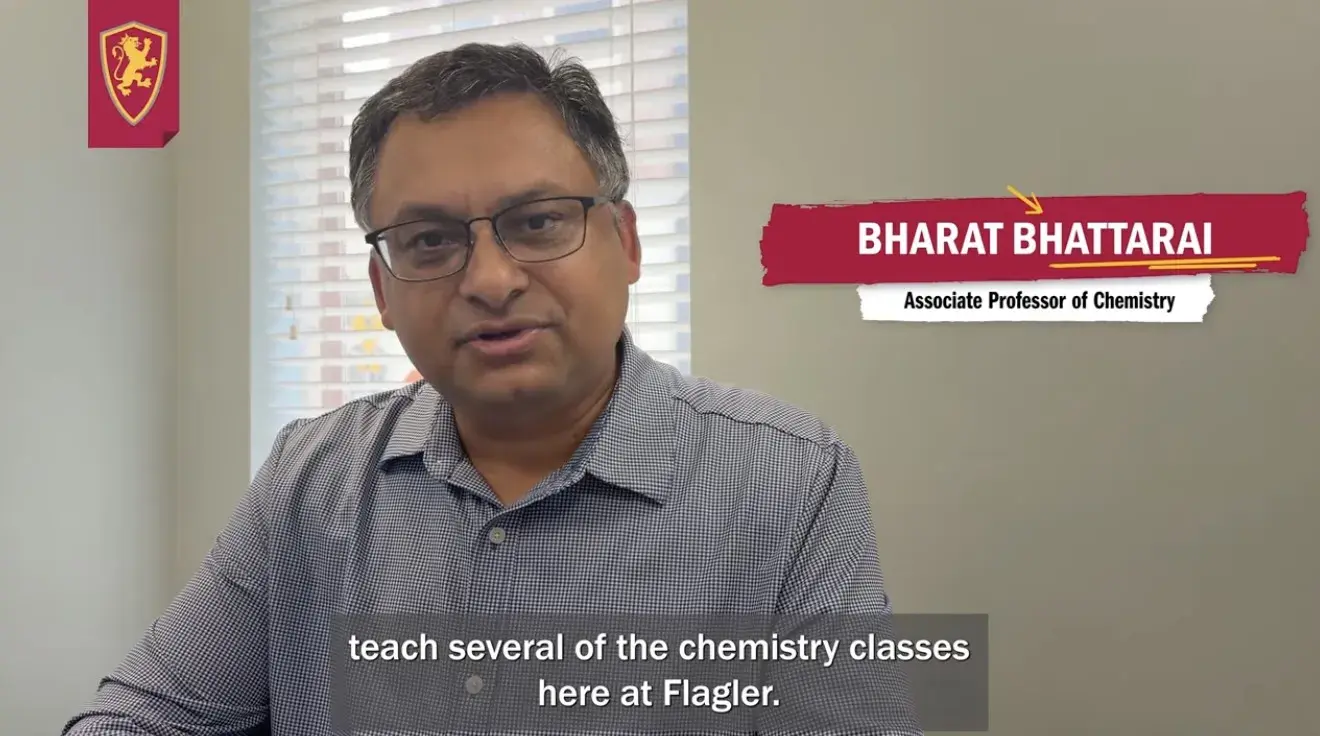
Tap the photo below to hear Dr. Bhattarai's response!
Q: What skills do you hope every student walks away from your class(es) with?
A: In General Chemistry: I establish a robust foundation by moving students beyond rigorous calculation toward scientific reasoning. My goal is for them to master fundamental principles such as atomic structure and thermochemistry while developing essential analytical and data analysis techniques in the laboratory. This phase is critical for building the technical confidence needed for higher-level inquiry.
As the field increasingly intersects with medicine in Organic Chemistry, I shift the focus toward mechanistic thinking. I challenge students to understand how molecular structure influences reactivity, specifically through the lens of structure-activity relationships (SAR) and drug action. In the lab, they gain intensive, hands-on experience in synthetic organic chemistry, learning to build and analyze complex molecules.
By connecting these classroom concepts to real-world biochemical processes and pharmaceutical development, I ensure my students are not just learning facts but are developing the problem-solving ability and communication skills required for the modern scientific workforce. Whether they pursue graduate research, professional medical degrees, or industry careers, they leave my courses equipped to navigate the complexities of an ever-evolving field.
Q: If you could take one Flagler class outside your department, what would it be?
A: I would like to take EDU 242 – Instructional Design for Teaching and Learning. This course offers a deeper exploration of strategies for creating more engaging classrooms, including hybrid and flipped classroom models, as well as approaches that emphasize discussion, collaboration, and application. It would provide a valuable opportunity to learn and implement effective teaching methods in my own classroom.
Q: What’s your favorite spot on campus—and why?
A: The Dining Hall is one of my favorite places on campus. I love it because there are so many food choices, it looks like a room from "Hogwarts," and there is plenty of space to spend time with coworkers or students. With its beautiful Tiffany stained glass windows and large oak pillars, even a quick coffee break feels special. It is a famous spot where you can learn about Flagler history while you work or relax without feeling crowded.
Q: Coffee or tea? (And where’s your go-to spot in St. Augustine?)
A: The Starbucks at the Casa Monica is my absolute favorite spot for a quick escape after classes. I love taking a quick scenic afternoon walk around the beautiful historic downtown area and soaking in the vibrant energy of the city. I usually use their app to order ahead, an Iced White Mocha with Sweet Cream Cold Foam. I equally enjoy grabbing my drink and relaxing on the outdoor terrace when the seats are available to enjoy the hotel's Mediterranean charm and wrap up my school day.
Q: What book, movie, or podcast are you currently enjoying?
A: I regularly watch TED Talks on global politics, socio-economic issues, and culture, which help broaden my understanding of contemporary global challenges. I also spend a significant amount of time listening to the podcast Let’s Talk Chemistry by “ChemTalk”, where leading researchers and Nobel laureates discuss a wide range of topics in chemistry.
Recently, I watched the TED Talk “Challenge Your Perceptions” by UCLA professor Neil Garg, where he shares innovative approaches to teaching organic chemistry and explains how he makes chemistry one of the most engaging courses on campus.
Q: What’s something your students would be surprised to learn about you?
A: They have no idea how much I love “Taylor Swift”.
Q: What is your go-to pump-up song?
A: My favorite song of all time is "Roar" by Katy Perry. Whenever I hear it, the music gives me a lot of energy and makes me feel strong. It is the perfect song to listen to when I need to feel motivated to get things done.
Q: What is your favorite pair of shoes, and how do they reflect you as a faculty member?
A: I like wearing my gray Nike Air Max sneakers- they’re comfortable enough for all-day walking and pair well with both khakis and jeans. They’re also perfect for semi-formal, casual occasions during the semester, since I don’t have to worry much about polishing them or matching colors.