

The Coastal Environmental Science major and member of Flagler College’s women’s lacrosse team was looking to expand her academic experience beyond the classroom when she applied to more than 20 undergraduate research programs related to water, the environment, and aquatic ecosystems.
One of those applications led to South Bend, Indiana, and the University of Notre Dame.
Selected for a highly competitive National Science Foundation Research Experiences for Undergraduates program, Tucker spent 10 weeks this past Summer conducting aquatic environmental research alongside scientists and fellow undergraduate researchers from across the country.
Under the guidance of Jennifer Tank, her principal investigator, and Mitchell Liddick, a doctoral student who served as her mentor, Tucker designed her own environmental DNA sampler, developed a method for extracting DNA from it, and presented her research at a university-wide symposium.
The experience also helped her discover a future she had never seriously considered before.
For 10 weeks, Tucker worked alongside scientists, Ph.D. candidates, and fellow undergraduate researchers, learning from the people around her while contributing to the collaborative work of the lab.
“I think having that team mentality really helped me integrate well,” Tucker said. “I was ready to help them and chip in on their projects, and they, in turn, helped me and chipped in on my project.”
That collaborative mindset came naturally to Tucker. As a student-athlete, she was already accustomed to working toward a common goal and relying on the people around her.
“I’m glad that I wasn’t afraid to ask questions and have my colleagues break things down for me,” Tucker said.
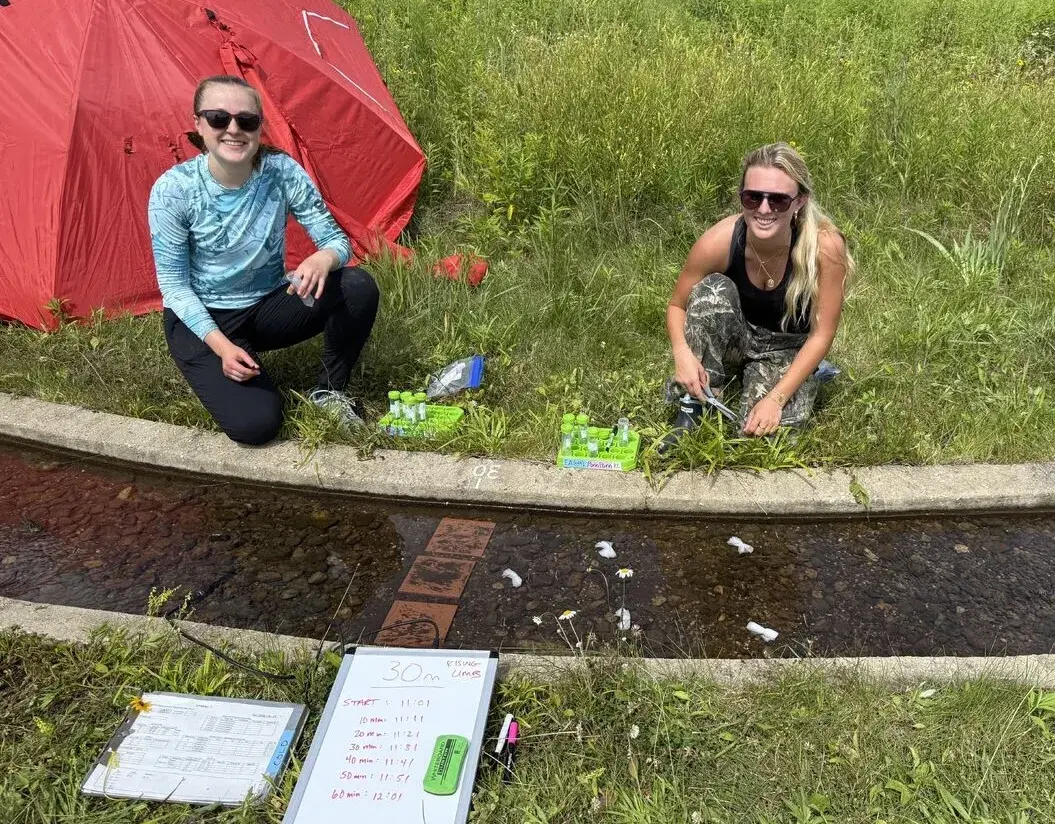
Tucker's own project focused on environmental DNA, or eDNA, genetic material that organisms naturally leave behind in their surroundings. She was tasked with exploring whether a passive sampler could collect that DNA and potentially offer researchers another tool for monitoring aquatic ecosystems.
“There’s environmental DNA everywhere. For example, we (humans) shed skin cells in the environment at all times. So, all organisms are doing a form of that,” Tucker said. “Basically, we were just trying to find a way to track the dynamics of eDNA in the water column across distance and over time.”
The project gave Tucker significant ownership over the research process. She developed a proposal and timeline, designed her own experiments, created her own version of the passive sampler, and developed a method for extracting the DNA it collected.
She had just 10 weeks to do it.
“I was working really long days,” Tucker said. “I even worked a 17-hour day on my experiment. It was crazy.”
No two days looked exactly the same either, and Tucker could arrive at the lab expecting to focus on one part of her project before finding herself helping with another experiment or analyzing a different set of samples.
The experience gave her a deeper appreciation for the process behind scientific discovery.
“There’s just a lot that goes into the process that I wouldn’t have really thought of,” Tucker said. “To make it a publishable study, you have to do background samples everywhere and make sure you really write down the times and information.”
By the end of the summer, Tucker had the opportunity to present her research at the University of Notre Dame Summer Undergraduate Research Symposium.
The experience challenged her to explain a complex scientific project to professors, fellow students, and visitors from outside her field.
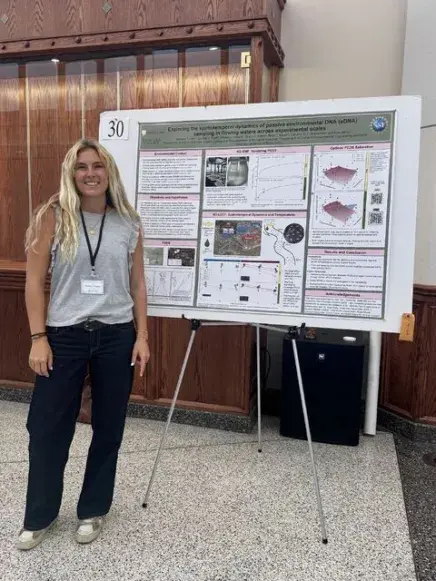
“It was really cool to explain my research to people in a way where they would understand the why behind what I was trying to do and then the steps I took to achieve it,” she said.
But the most significant outcome of the summer extended beyond her research findings or the symposium presentation.
Before arriving at Notre Dame, graduate school was not on Tucker’s radar. She loved science and had a strong interest in environmental research, but spending the summer alongside graduate students gave her a firsthand look at the opportunities available beyond her undergraduate degree.
“I hadn’t really considered graduate school as an option or realized that there were programs that provided funding,” Tucker said. “So, it opened this whole different world to me that I wasn’t really familiar with.”
Now, Tucker plans to pursue a master’s degree and eventually a Ph.D.
“I love learning about science and I love conducting research, so I want to keep doing it,” she said.
The project itself may also continue beyond the summer. Liddick has offered to continue developing the research as part of his dissertation, and Tucker expects to remain involved in the writing process and help move the paper toward publication as the research continues.
As Tucker returns to Flagler for her senior year, she is bringing back new skills and a clearer vision for her future, one that now includes graduate school, a Ph.D., and a continued pursuit of environmental research.