

Growing up in South Georgia, nearly two hours from the nearest coastline, Marchant found herself drawn to what she could not easily access.
“The unattainability of coastal environments made the idea of the ocean and all of its inhabitants very intriguing to me,” she said.
That early curiosity first centered on marine life, but as she explored her interests more deeply, it evolved into a broader passion for animal health and care. By her sophomore year, Marchant set her sights on veterinary medicine, a goal that would shape the rest of her academic journey.
That goal led her to Flagler College, where she initially enrolled as a coastal environmental science major with a minor in biology. At the time, she knew she had a passion for science, but not yet a defined career path.
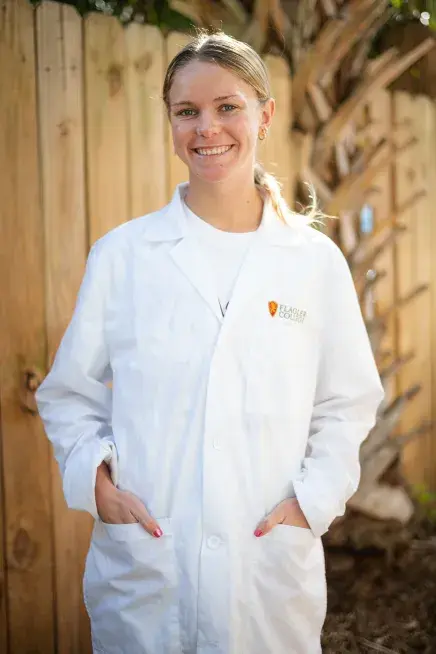
Over time, that path came into focus.
After completing the requirements for both her major and minor in just three years, Marchant faced a decision. She had planned to leave Flagler to complete additional prerequisite courses for veterinary school elsewhere. Instead, an opportunity to stay for her final year as a student-athlete prompted her to reconsider.
“I was already familiar with the staff in the science department here, so when given the opportunity to stay, I felt it was the best decision for me,” she said.
That decision led her to expand her academic focus, turning her biology minor into a second major and fully immersing herself in the program, while continuing to build toward her goal of veterinary school through hands-on experience in clinical settings and internships.
At Flagler, Marchant found that studying science extended far beyond lectures and textbooks. The College’s coastal location in St. Augustine became an integral part of her education, offering hands-on experiences that brought complex concepts to life.
Courses such as Ecology, Marine Biology, and Dolphin Biology incorporate fieldwork directly into the curriculum. Weekly boat outings to observe dolphin behavior and research projects involving local sea turtle populations provided opportunities to engage with real ecosystems in real time. "Learning about these subjects in a classroom is good for a base knowledge,” Marchant said, “but a lot of what we learn is what is going on outside of the building we sit in.”
“Being immersed in the world around me not only made what I learned much more enjoyable and applicable but also helped me truly learn rather than simply memorize textbook information for an exam,” continued Marchant.
A defining moment in Marchant’s academic journey came through her capstone research project, a culmination of the skills she developed throughout her time at Flagler.
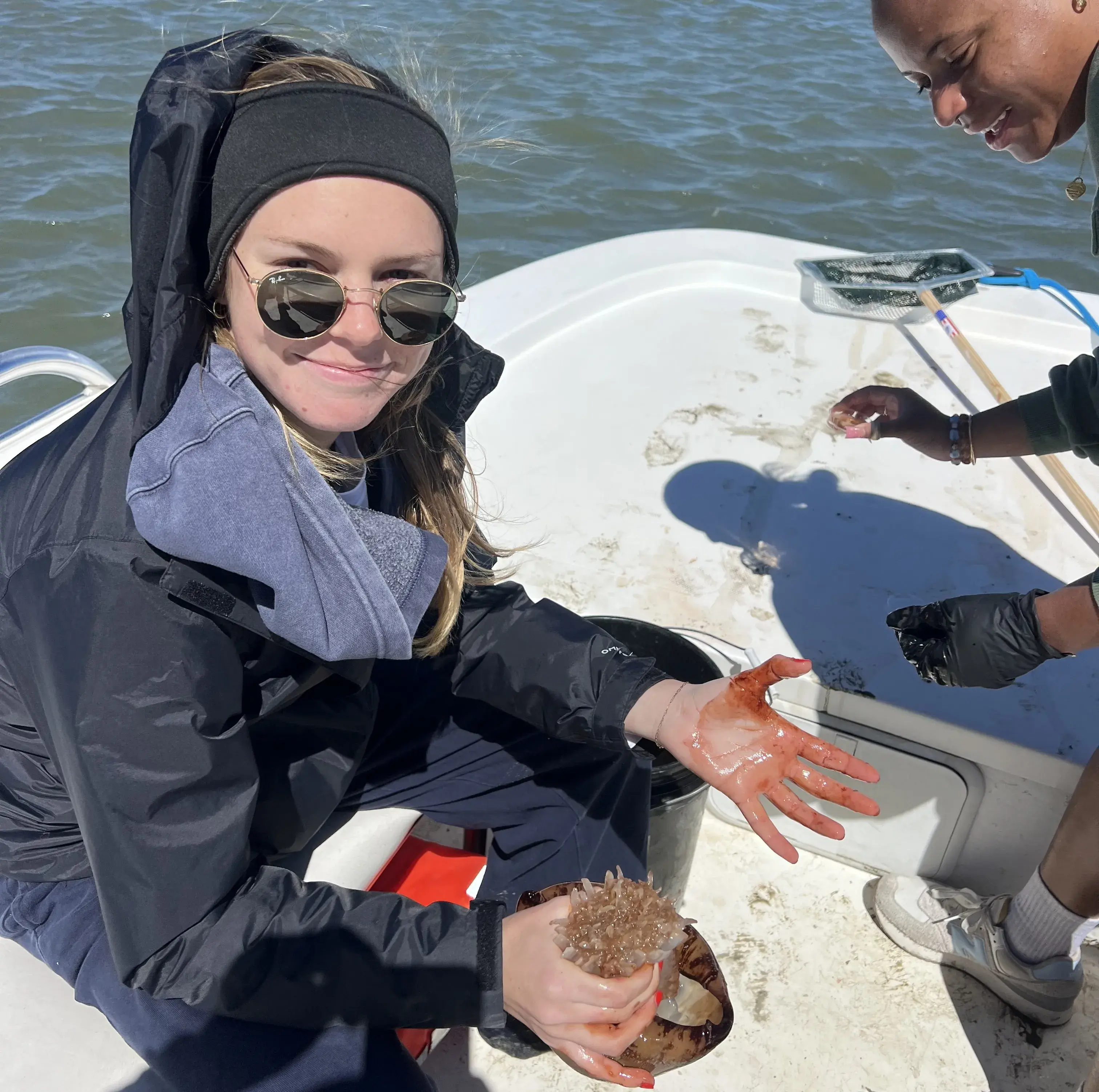
Working with a team, she studied the effects of cannonball jellyfish mucus on the regeneration rates of planarians, a type of organism commonly used in biological research that has the unique ability to regenerate lost body parts.
The project investigated the effectiveness of jellyfish mucus on regeneration, which led to the question of whether collagen found in jellyfish could serve as a more sustainable alternative to traditional sources used in medical and commercial applications.
The research combined fieldwork, lab techniques, and analytical thinking, allowing Marchant to apply knowledge from both her biology and coastal environmental science studies.
“By the time we reach our last year, we’re required to complete a capstone research project to put into practice what we’ve learned,” she said. “Having the freedom to semi-independently study a topic my group chose gave me confidence in my research skills and in my growth as a scientist.”
Faculty mentorship played a key role throughout that process. Professors such as Dr. Doiron and Dr. Veenstra provided guidance, support, and individualized attention, helping Marchant navigate both her research and her long-term goals, including her path to veterinary school.
“The small class sizes and one-on-one learning opportunities made a huge difference,” she said. “My professors have always been willing to take the time to make sure I fully understood the material.”
Balancing two science majors while competing as a student-athlete required discipline, adaptability, and strong time management skills. Marchant credits that experience, along with her coursework, research, and clinical work, with preparing her for the next step in her journey.
This fall, she will begin pursuing her Doctor of Veterinary Medicine at the University of Georgia College of Veterinary Medicine, joining the class of 2030.
Reaching that milestone was not without challenges. After deciding to pursue veterinary school during her sophomore year, Marchant worked closely with faculty advisors to map out the necessary steps, gaining hands-on experience through clinic work and internships as she completed her degree.
“I believe the small school environment at Flagler has provided me with a unique and specific education that can be tailored to each student’s interests and career goals,” she said.
As Flagler’s biology program continues to expand, students like Marchant highlight the opportunities available through its evolving curriculum, research offerings, and faculty mentorship.
“The opportunities are only becoming more abundant now with more courses, professors, and research opportunities as the new biology major grows,” she said. “I think the experiences gained here really stand out, especially for students interested in graduate school.”
Looking back, Marchant sees her decision to stay at Flagler and pursue a double major as one of the most impactful choices of her college career, one that allowed her to turn early curiosity into a clear and confident future.
“Despite a sometimes-challenging workload, I couldn’t think of another place I would want to do it,” she said. “The professors, the research experience, and the environment all combined to make it an unforgettable four years.”