

New York 2026 Fieldwork
Overview
Overview
For fourteen days (May 8 - May 22, 2025), Dr. Yiorgo Topalidis had the honor and privilege of visiting with and learning from descendants of Ottoman Greek migrants in New York. This was also the first year that two Flagler College students (Chris Kloosterman and Jack Bellars) joined me through the FlagSHIP program! While there, we traveled 715 kilometers, conducted 14 interviews, and documented 209 images. This information will be added to the Ottoman Greeks of the US Digital History archive.
The following short essays highlight those interviews.
Fieldwork, Day-by-Day
Fieldwork, Day-by-Day
Day 1 - The Medal from Pergamos
Day 1 - The Medal from Pergamos
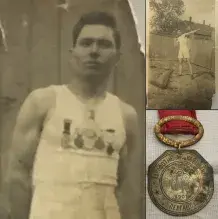
On the first day of research in New York, we learned about the presence of an Ottoman Greek organization in the Ottoman Empire. The donor, “Nikkie,” knew that her paternal grandfather, “Mike,” had been a track-and-field athlete from his early days. Mike was born in Pergamos (Trk. Bergama), a town in western Anatolia, and settled in New York City. During Nikkie’s interview, we learned that Mike won a first-place medal in the long jump at a track-and-field competition organized by the Brotherhood of Agia Kastriane in Pergamos in 1906. The medal indicates that the organization was established in 1901. Mike continued competing in track and field, earning second- and third-place finishes at meets in Boston and Peabody in 1912 and 1917, respectively. In this photo, Mike is wearing the medals he won in Peabody in 1917 and also proudly displaying his medal from Pergamos.
Day 2 - "The suitcase was always full of clothes"
Day 2 - "The suitcase was always full of clothes"
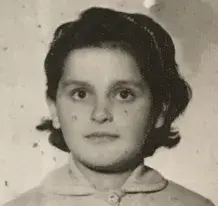
On this Mother’s Day, we commemorate the struggles of the migrant mother through the experience of “Eva.” Eva is a third-generation descendant of Ottoman Greek refugees from a small village on the outskirts of Trapezounta (Trk. Trabzon), who settled in a predominantly Pontic village in Kozani. Eva loved nature and fully embraced her agrarian lifestyle. When she turned nineteen, her father arranged her marriage to a young man, John, who was also a descendant of refugees but had already established himself in New York City. A local village boy who had been courting Eva tried to convince her to stay, but her father was adamant: “Now it is done.” Immediately after their nuptials, Eva and John moved into a small apartment of a multi-floor complex in New York City. According to Eva, “our apartment was so close to its neighboring building that you could not even see sunlight.”
One day, she ventured out to a nearby market to purchase the household's necessities, with no working knowledge of English and her apartment address in hand. She made a mental note that her building had a mound of garbage bags out front, but when she returned, they were gone. She cowered on the side of a nearby alleyway and cried fearful, silent tears for what seemed like eternity. “People passed by and looked, but no one stopped. Then an older man with a cane passed, but then turned back to address me in English. I fought through my tears to describe my situation with hand gestures and Greek. That is when he replied in Greek, ‘Don’t cry,’ and used the address to lead me to my apartment.”
On that day, and every day after, Eva committed herself to returning to Kozani. “When Charlie came home, I took down my suitcase and filled it with clothes. ‘It is nighttime, he said. Where will you go? Listen, I am your family now. I am here to protect you. I am saving money, and we will move to a home eventually.’ But I was not convinced. Every day I took the suitcase down, filled it, and then put it back. Days, months, years passed, but the suitcase was full of clothes.”
Charlie kept his word. They purchased a two-story home, and he protected her, but Eva’s commitment to return never wavered. With two children in tow, she and Charlie moved back to Greece and fought to remain there for six years. They established a business in Thessaloniki, only to burn through their savings, see it fail, and experience a second move to New York City.
Eva’s spirit to return to her village persists. Now a grandmother, she longs for her past life working the fields of her village and caring for the family’s farm animals. “I loved that life! The clean air, sharing time and space with friends and family members in the fields. Great memories!” Eva’s story reminds us that migrant women are often forcefully detached from their agency and coerced into settling in the US, but some women, mothers, and grandmothers resist assimilation and reject the American dream.
Day 3 - From Avşa to New York City
Day 3 - From Avşa to New York City
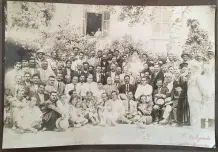
The islands in the Sea of Marmara (Marmara, Ekinlik, Imrali, and the Prince Islands) were the origin of many migrants who settled in the US in the early 20th century. On the third day of our research in New York City, “Peter” made the first contribution to our archive regarding the island of Avşa (Grk. Afisia). According to Peter, Avşa was evacuated by an American ship near the end of the 1910s. “They were given a choice to settle in Thessaloniki or Lavrio. They heard that refugees at the outskirts of Thessalonike were famished and diseased. So, they decided on transport to Lavrio instead.” Peter and his family settled among many other Afisians in Lavrio, but he lamented his family’s decision to leave the coastal community. “We never should have departed for Neos Pyrgos. That was a big mistake.” Peter worked to the point of exhaustion as a teenager to help his family make ends meet, and as a result, did not finish grade school until the age of fifteen. Thereafter, he joined the merchant marines and traveled the world as a second cook in the kitchens of ocean liners. He was the only member of this family to settle in the US. His last journey on a tourist visa brought him to New York City, where he settled permanently.
Day 4 - FlagSHIP Kickoff
Day 4 - FlagSHIP Kickoff
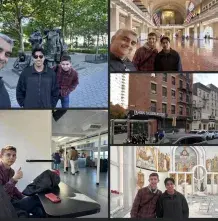
Our FlagSHIP program kicked off yesterday with the arrival of two Flagler College students, Jack Bellars and Chris Kloosterman. As with many Ottoman Greek migrants, they immediately traveled to Ellis Island. On the Battery Park promenade, we discussed the significance of Castle Garden, the City’s first immigration station.
During our ferry ride to Ellis Island, Dr. Topalidis referenced the frantic race that many ships carrying Ottoman Greek migrants were forced to make due to the restrictive Immigration Acts of 1921 and 1924. Those laws allowed only 100 Ottoman and Greek nationals to enter the US per year. Dr. Topalidis cited the Acropolis and the Madonna as a case study he published under the guidance of Dr. Ortiz, Ms. Deborah Hendrix, and Ms. Tamarra Jenkins at UF’s Samuel Proctor Oral History program. The S.S. Acropolis brought 200 refugees from Smyrna to Ellis Island, only to see them deported back to Piraeus on the S.S. Madonna because the quotas for Armenians and Greeks had been exhausted by December of 1922.
Landing on Ellis Island, Dr. Topalidis reminded the students of the anxiety and fear that many faced of being detained, held in quarantine, or deported on a case-by-case basis. As the students walked through the building, we talked about the questioning, documentation, and medical exams that Ottoman Greek migrants were subjected to. We continued our journey with a brief walk through the Lower East Side, where Dr. Topalidis indicated the approximate location of the Brotherhood of Marmarians at 25 Madison St. That location served as a safehouse, and its members helped migrants from Marmara find jobs and accommodations. Our travels concluded with a visit to St. Nicholas Greek Orthodox Church and a discussion of the site’s significance to Ottoman Greek migrants.
Day 5 - "No Gold-Paved Streets Here"
Day 5 - "No Gold-Paved Streets Here"
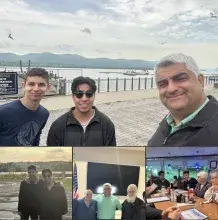
The City that promised stability and prosperity did not deliver it for everyone. For some, it did not provide a fair wage for a fair day’s work. Others could not bear another day within the steel cogs that made New York City run. So, like many Ottoman Greek migrants, our time in New York City was short-lived. On day five, our journey took us north to the capital of the Empire State. We made a brief stop on the shores of Newburgh, like many migrants who traveled on foot, in carriages, by boat, by train, and eventually by bus, depending on what their financial means allowed. Upon arrival, friends from the same village, town, and city in the Ottoman Empire greeted us; they had earlier traveled to Albany and settled there. We visited St. Basil’s Greek Orthodox Church and joined the community in fellowship. Father Emannuel, Art, Stephanie, and Despina welcomed us with a warm embrace that we last felt in the arms of our loved ones in the Ottoman Empire. What will tomorrow bring? We will learn from their stories and decide our next steps.
Day 6 - Muhabeti in Albany
Day 6 - Muhabeti in Albany
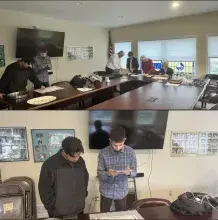
The word muhabeti (also parakathi), like so many other words, entered the Pontic Rümca language through Arabic and Ottoman (muhabbet). It is defined as “the practice of dialogical singing of the Pontic Greeks or Pontians” (Tsekouras 2024: 21). In practice, a muhabeti is a social gathering where (mostly) men sing to the sounds of a kemence over dinner. The songs often venerate love or memorialize the trauma of refugeedom. “Anna’s” four children recalled that their mother survived such trauma. Ottoman soldiers forced her, her mother, and grandmother from their village, Karakevezit. They were led on a death march that only Anna survived. “Her mother would beg and scavenge for food, which she then gave to her children. She died of starvation.” Her grandmother also succumbed to the burdens of the march. One of the few objects she carried was an icon of the Virgin Mary, which the family has preserved. Our two FlagSHIP students, Chris Kloosterman and Jack Bellars, digitized and curated the icon, along with many other photographs, documents, and objects, during our muhabeti at St. Basil’s Greek Orthodox Church in Troy, New York.
Day 7 - The Boreki Pan
Day 7 - The Boreki Pan
By Jack Bellars
Third Year Undergraduate Student
Performing Arts - Theater Arts
Flagler College
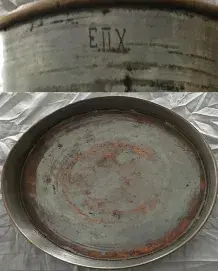
One artifact that stood out from the rest in today’s interviews was the boreki pan. Although it served an everyday purpose compared to the other artifacts we digitized, its distinct design holds sentimental and historical value. The pan is a mystery to the family. According to one of “Anna’s” grandchildren, “Ari”, it has Greek letters written on its side, perhaps indicating the maker or distributor. It is likely made of hand-hammered copper by an early-20th-century Ottoman housewares artisan. Ari asserts this because of the “heavy gauge copper, the hand-worked rim, and the minimalist struck mark.” After the interview, the interviewees expressed that they felt unable to contribute much to our research. But this artifact, combined with their memories of Anna and their community, is invaluable.
Day 8 - The Power of Prayer
Day 8 - The Power of Prayer
By Chris Kloosterman
Anthropology - Public Archaeology
Flagler College
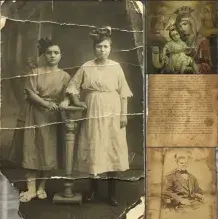
The artifact from today’s interviews, an icon of Jesus and Mary, was a powerful reminder of how objects carry history. While the front of the piece showed a familiar religious scene, the back contained significant details. It featured a portrait of a man and a long passage of Russian text explaining the image's origins and identifying it as the icon of the Mother of God.
The text on the back, in Russian, describes a miracle involving a monk and a mysterious stranger on Mount Athos. I am not a native speaker, so as we learned in Dr. Topalidis’s class, I used Google Lens to translate the text and deciphered the following to the best of my ability. According to the story, a guest who was actually an archangel appeared in a remote cell and sang a new hymn that had never been heard before. The monk had no paper or ink, and the angel miraculously engraved the words into stone. This story transforms the icon from a work of art into a record of a supernatural event. Seeing this text on the back of the artifact made it clear that for the owner, the object is a physical connection to a moment of divine intervention.
The addition of a (unknown) man’s photograph on the back suggests a personal history layered on top of the religious one. As her children indicated during the interview, the icon was “Anna’s (standing left)” cherished possession because it connected her to her past life in Pontos. The icon also represents a link between the legend of the angel, the power of prayer, which Anna strongly believed in, and the history of her family. Finally, the icon shows that people do not just keep these objects for their religious value, but because such objects represent the experiences of their ancestors.
Day 9 - Cold, Foreign, Buffalo
Day 9 - Cold, Foreign, Buffalo
By Chris Kloosterman
Third-Year Undergraduate Student
Anthropology - Public Archaeology
Flagler College
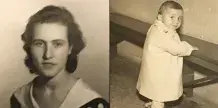
Oral history does something special by connecting historical events directly to real human lives and emotions. Watching the interview of “Matt,” who left Greece as a kid alongside his mother, “Stella,” showed me a very clear, powerful takeaway about the immigrant experience. It proved that moving to an entirely new country is not just a single moment in time, but a long and difficult team effort between a parent and a child. While the young child grows up quickly, adapting to a brand-new culture, the mother is the one who carries the heavy memories and daily sacrifices required to make that massive life change possible.
Matt’s early memories of moving across the world were just small, blurry pieces of a puzzle. Later in life, he relied completely on Stella’s detailed stories to understand where he came from and what the journey across the ocean actually felt like. Stella’s paternal grandfather had escaped the destruction of Smyrna in 1922. They were initially settled in Florina before being transferred to Nea Potidia. Stella had to handle all the stressful, hard work of leaving Nea Potidia, in Chalkidike, behind and settling in cold, foreign Buffalo, New York. She bore the constant, quiet pressure of keeping her family safe and housed while trying her best to hold onto their proud Greek traditions in a completely foreign environment. “I did not feel welcome, and I wanted to return home. Greeks here made me feel inferior because I could not speak English,” she stated more than once.
Stella and John’s interview showed how family heritage manages to survive over the decades through two very different, yet deeply connected, viewpoints. The mother worked tirelessly to keep their Greek identity, language, and cultural traditions alive inside the home, while her young son grew up learning how to balance being both fully Greek and fully American outside. The old photo of the little boy in his neat coat reminds us that every single immigration statistic we read about in history textbooks represents a deeply personal human life. Their shared memories show that local communities are built entirely on these brave family journeys, where a mother's hard work directly creates a successful new future for her child.
Day 10 - The Seagull
Day 10 - The Seagull
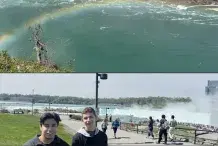
In Florida, we often think of the seagull as a pest, complicating our beach visits by petitioning us for food and lingering in our space mid-flight, but those behaviors have imbued them with a different meaning in literature and poetry (Rogers 2023). Seagulls symbolize the migrant. They are there to prepare us for the journey ahead. Their calls reassure us that “all will be okay.” They even fly alongside our vessels, wishing us well and showing the path as we set forth. And they are there when we arrive, warmly receiving us: “How was your journey? See! We told you everything would be okay!” When Chris and Jack arrived at JFK, seagulls were there to greet them, and on our last day in Buffalo, they were there to wish them a safe return. Στο επανιδείν!
Day 11 - The Amanatides and the Pakatarides
Day 11 - The Amanatides and the Pakatarides
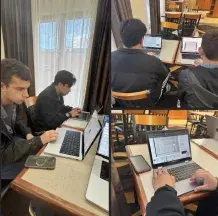
According to the Ellis Island Foundation's passenger list archive, two Ottoman Greek families that settled in Albany were the Amanatides and the Pakatarides. During their FlagSHIP program, Chris and Jack conducted univariate (nationality, race, city of birth, country of birth) and bivariate (nationality-race X city of birth-country of birth = “place of birth”) frequency analyses of the passenger lists that included members of these two families. The students found that a slight majority of their sample (n = 53) were documented as Turkish nationals (n = 28). The second-largest documented nationality was Greek (n = 20); the remainder (n = 5) were neither. For race, most were documented as Greek (n = 34). Hebrew was the second largest category (n = 7). The remainder were documented on the passenger lists as follows: NA (n = 5), American (n = 4), Turkish (n = 1), Armenian (n = 1), Ottoman (n = 1). For “place of birth,” the majority were listed as born in Turkey (n = 40). The second largest reported category was Greece (n = 10). The remainder were illegible. The Amanatides and Pakatarides were listed as born in “Turkey,” and categorized as “Turkish” nationals of “Greek” race.
After Chris and Jack completed their univariate analysis, we conducted a bivariate analysis (nationality-race X city of birth-country of birth = “place of birth”) and discussed the implications of their results. We found that at least 20 migrants were dual citizens of Greece and the Ottoman Empire (listed as Greek nationals, born in the Ottoman Empire), and 28 were Ottoman (Turkish) citizens of Greek “race.” To understand the implications of these findings, we discussed the origins and meanings of the “nationality” and “race” variables in the passenger lists (Benton-Cohen 2018, Perlmann 2018, Topalidis 2022).
Citations
Benton-Cohen, Katherine. (2018). Inventing the Immigration Problem: The Dillingham Commission and Its Legacy. Harvard University Press.
Perlmann, Joel. (2018). America Classifies the Immigrants: From Ellis Island to the 2020 Census. Harvard University Press.
Topalidis, Y. (2022). Forging an Anti-Racist Praxis: Housing Discrimination against Ottoman Greek Immigrants in Early-Twentieth-Century Portland and Seattle. Journal of Urban History, 50(4), 858–881. https://doi.org/10.1177/00961442221101042
Day 12 - The Pontos Society of Watervliet “O Pontos”
Day 12 - The Pontos Society of Watervliet “O Pontos”
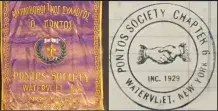
According to existing scholarship, Ottoman Greek migrants established 149 social organizations in the US in the early 20th century (Papadopoulos 2021). They aimed to preserve and promote the culture and traditions of their homelands in their US-based communities. While visiting Albany, the descendants of such an organization shared evidence with our project that has not been documented in scholarship. The Mutual Aid Society “O Pontos” of Watervliet, NY, was established in 1929 by migrants from Pontos. There was a separate Pontic organization in Albany, NY, and the two merged in 1941. At its height (1952 and 1957), the society had 27 dues-paying members and organized picnics and other community get-togethers.