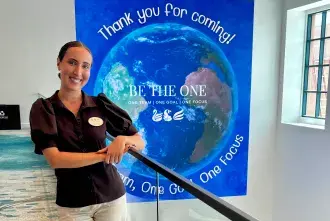


Last summer, Mortensen spent nearly three weeks aboard a research vessel in the Arctic Circle as part of Project Blue Echo, an ambitious ocean research mission led by The Seabirds Foundation in partnership with the National Oceanic and Atmospheric Administration. The project focused on collecting critical ocean health data in some of the world’s most data-scarce marine regions, including waters off Greenland and Norway.
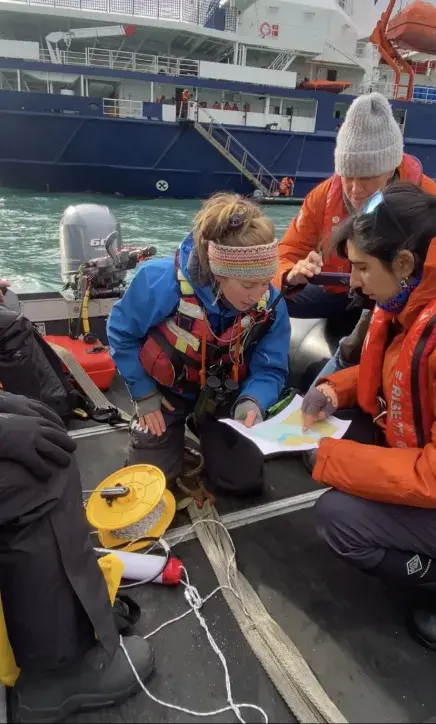
During the expedition, Mortensen assisted in collecting acoustic data and key ocean health indicators such as pH, salinity, temperature, turbidity, and depth.
“Collecting acoustic data and ambient underwater soundscapes helps scientists track noise pollution and marine life behavior,” Mortensen said. “The sounds captured are used to study noise levels as well as biological and physical activity in the ocean. These recordings allow scientists to monitor marine life behavior, identify the presence of marine species, and detect human-made noise pollution."
Mortensen’s role extended well beyond data collection. She documented findings in real time, organized digital databases, coordinated research schedules, and helped deploy oceanographic equipment from Zodiac vessels. She also communicated project updates to other scientists, photographers, and documentary filmmakers on board.
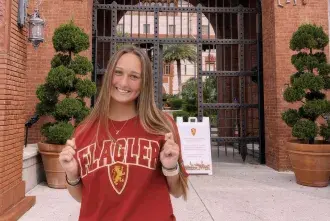
That ability to bridge disciplines and audiences has become a defining feature of Mortensen’s career. After graduating from Flagler, she earned a master’s degree in international law from the United Nations-mandated University for Peace, where she further developed her interest in global governance and environmental protection.
Majoring in international studies and coastal environmental science at Flagler laid the foundation for that interdisciplinary approach.
“Through interdisciplinary coursework, I was able to see the connections between environmental science and international policy,” Mortensen said. “I loved being able to have variety in what I learned throughout the day and engage in meaningful discussions with professors. That level of access and engagement is something you don’t always find at a larger university."
She also credits Flagler’s location with shaping her academic experience.
“St. Augustine, in and of itself, is an incredible playground for coastal environmental sciences,” she said. “Being so close to the coast allowed for numerous opportunities for science courses that took place outside, actively observing the environment around us. That coursework and environment are what ignited my natural curiosity.”
Mortensen points to several professors who helped shape her path.
“I have to thank professors Lori Lee, Brenda Kauffman, Michael Butler, Ben Atkinson, and Barbara Blonder for playing such pivotal roles in my education,” she said. “It was truly a gift to have educators who cared about who you are as a person and were genuinely excited about your future.”
Two specific courses left a lasting impact on Mortensen and her career. Coastal Strand Ecology with Professor Barbara Blonder introduced Mortensen to field research, while the Summer 2017 Vietnam study abroad course with Dr. Michael Butler sparked her interest in international law and human rights.
"Collecting data and analyzing results always gave me a sense of awe,” Mortensen said. “You feel more connected to nature when you can see the indicators of its health and composition.”
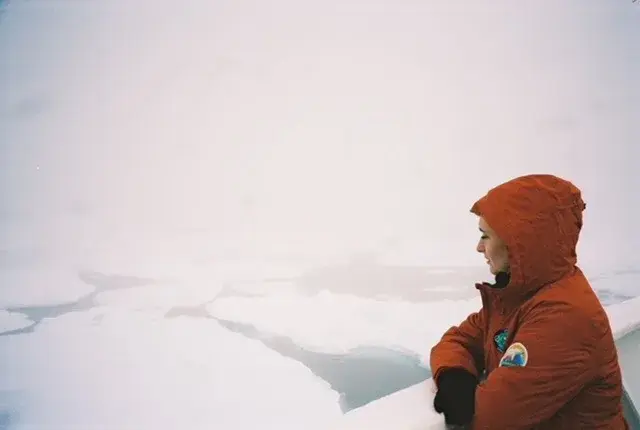
Today, Mortensen is working as an independent contractor in partnership with POLEs (Plankton Observations of Lifecycles and Ecobiomes) and Carvalho and Associates on a research-based memorandum that will be presented at the United Nations Environment Assembly. The memorandum draws on previous POLEs research, particularly in Antarctica, and focuses on policy development related to climate concerns, glacial runoff, and marine biodiversity.
“Data demonstrating the effect of climate change is what drives effective policy,” Mortensen said. “When research findings are communicated to policymakers, they can directly inform decision-making and lead to the implementation of policies that protect and preserve the planet.”
Mortensen has also gained experience in environmental advocacy through her work with the Turtle Island Restoration Network on its Coco-Galapagos project. The initiative seeks to establish a binational marine protected area between the Cocos Islands of Costa Rica and the Galapagos Islands of Ecuador.
Being part of projects that cross national borders has been a meaningful milestone.
“This is still a very new and emerging sector of my career,” Mortensen said. “However, it is already a significant accomplishment to begin working with international organizations. These global institutions have the capacity to reach a wider audience and possess a stronger platform for driving meaningful change.”
Storytelling has remained a consistent thread throughout her work. While in the Arctic, Mortensen authored blog posts for The Seabirds Foundation documenting the expedition and explaining why the research matters. She has also contributed writing to Women in Ocean Sciences, reflecting on conducting research in extreme environments.
Looking ahead, Mortensen continues to focus on work that bridges research and policy while advocating for the protection of the world’s oceans. She has recently been invited to apply to participate in the Earth Charter Global Summit for Youth in Climate Justice.
For current Flagler students, she hopes her path demonstrates what is possible.
“Take every opportunity available to get involved outside the classroom,” Mortensen said. “Allow your natural curiosity to guide you. The real key is to keep going. Keep applying. Keep networking. Keep learning.”
She also encourages students not to fear change.
“I hope they recognize that nothing is impossible for them,” she said. “If you know what you love and what you want to do, follow that intuition and do not let self-doubt stand in the way.”