

That experience unfolds in CDD 240 M J: Minecraft for Sustainable Design, a FlagSHIP course taught by Dr. David Moody. During the intensive two-week program, students from across disciplines work together using Minecraft: Education Edition to recreate Flagler’s campus while exploring how digital spaces can reflect cultural, historical, and sustainable values.
According to Moody, Minecraft allows students to engage in complex design work without being slowed by technical barriers.
“Minecraft is a platform that lets students do digital planning work without getting stuck at the software training stage,” Moody said. “It’s been around for over 15 years, and many students grew up with it. That makes it familiar enough that we can move quickly into thinking and making.”
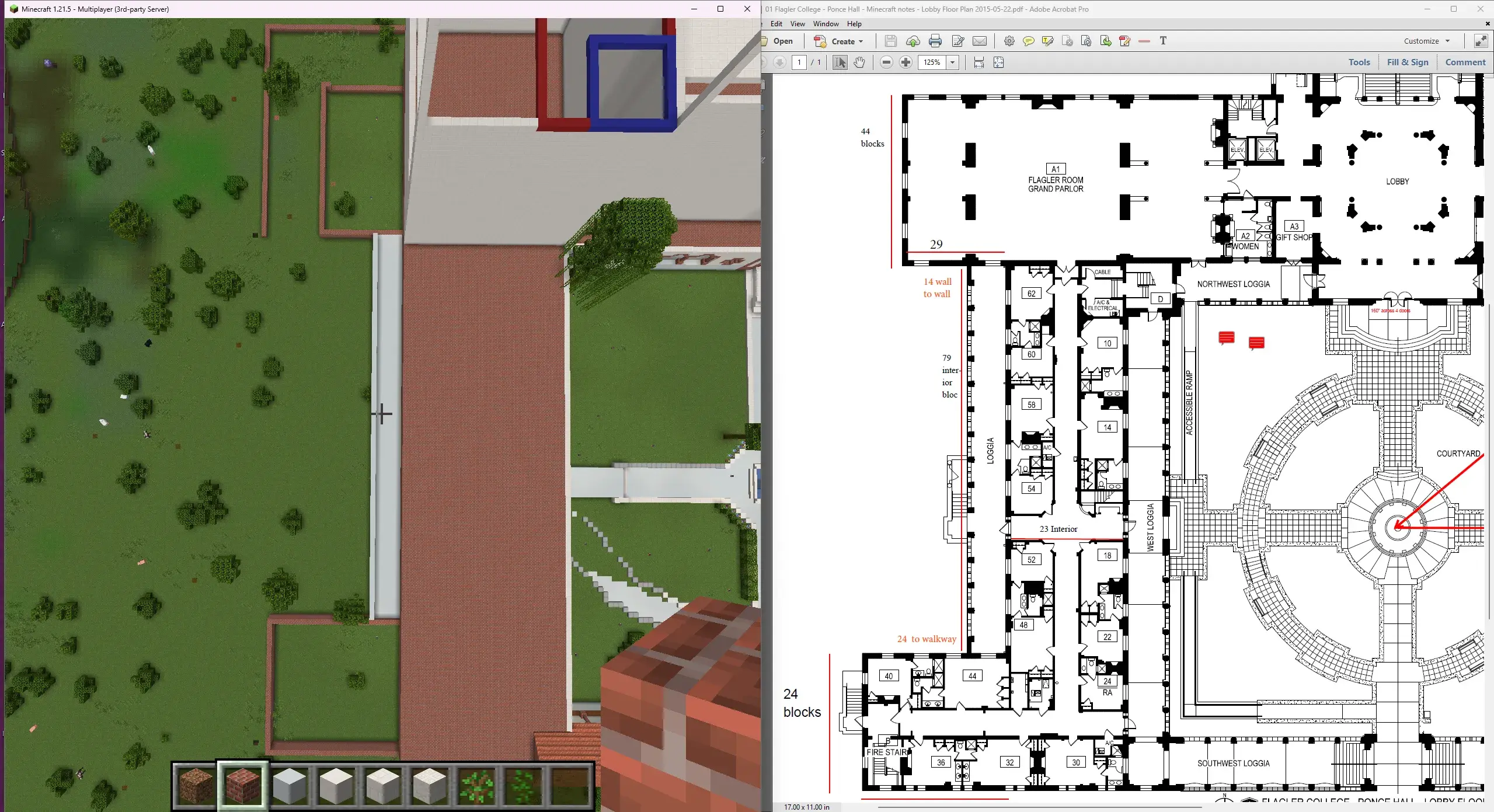
Inside the classroom, the work quickly becomes collaborative and intentional. Students break into teams, assign roles, and begin translating Flagler’s physical campus into a shared digital space. Every decision matters, from scale and structure to how pathways, gathering spaces, and historic buildings are represented.
As students move through their virtual campus, they test sightlines, circulation, and how spaces connect, gaining a deeper understanding of how design shapes experience.
“You can see how a courtyard holds people or funnels them,” Moody said. “You can test flow and movement simply by walking through the space.”
That blend of creativity and reflection sits at the heart of the FlagSHIP program. Building on the foundation of Flagler’s First-Year Seminar, FlagSHIP courses are designed to be immersive, experiential, and deeply human. They encourage students to step beyond traditional classroom models and engage with the complex social, cultural, environmental, economic, and political systems that shape the world.
Moody describes FlagSHIP as “a bridge between classroom learning and public-facing work,” noting that students are not only demonstrating knowledge but are producing something the College can use and build upon. “That’s immersive professional practice in miniature,” he said.
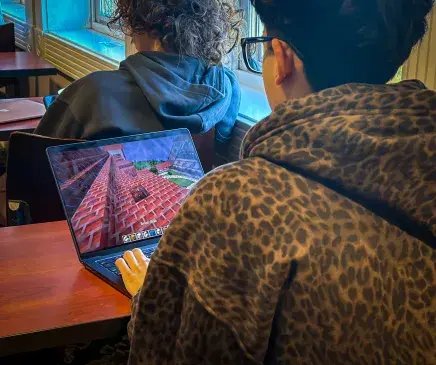
As the course progresses, students move beyond technical skill-building and into thoughtful conversations about access, perspective, and representation. Through reflective assignments and group discussions, they consider how campus spaces shape experiences for different members of the community, both physically and digitally.
By analyzing landmarks and reimagining them in a virtual environment, students gain insight into how design choices can influence movement and interaction.
The technical side of the course reinforces those lessons. Students learn the fundamentals of digital modeling and sustainable design while gaining hands-on experience with Minecraft and architectural visualization. They also develop project management, teamwork, and communication skills as they coordinate their work within shared constraints.
“Minecraft gives players a limited palette, so they have to be strategic about which details matter,” Moody said. “They also must adapt to one another, learning to collaborate and communicate in unfamiliar ways. If they can practice such skills in this FlagSHIP, they’ll be more prepared for adaptation when on site with new challenges.”
During a showing of the in-progress model, students shared the results of their two-week collaboration and reflected on the process behind the build. While the class was unable to complete the interior of every structure, the exterior shells now stand as a foundation for future FlagSHIP courses to build upon.
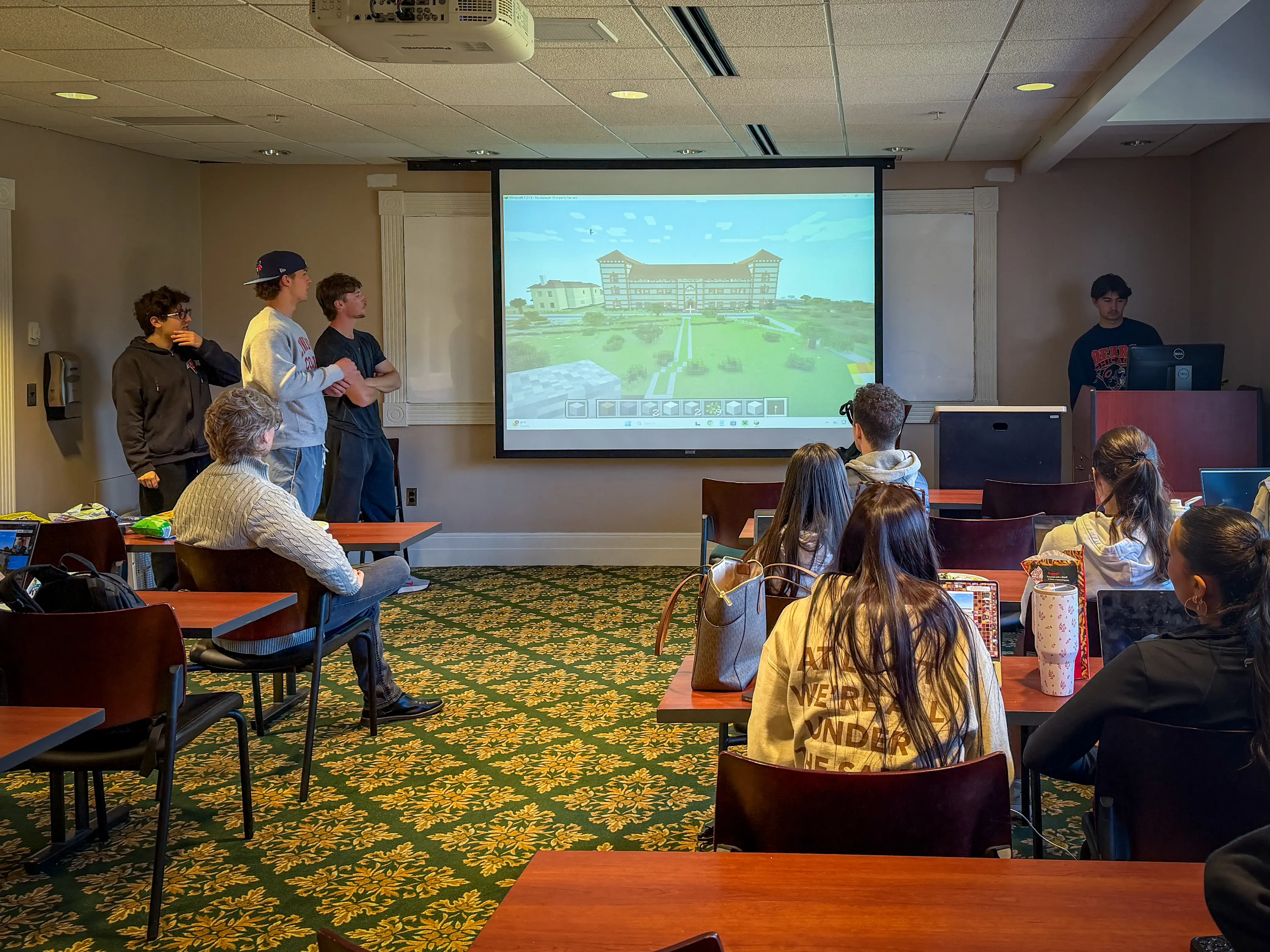
Working outward from Ponce de Leon Hall, which was prebuilt for the class, student teams recreated several key campus buildings, including the Crisp-Ellert Art Museum, Alumni House, Proctor Library, Markland House, Wiley Hall, and the Dining Hall. One group also began developing the interior of Ponce de Leon Hall, offering a glimpse of how future iterations of the project could expand beyond the exterior. To ensure accuracy, students worked directly with campus employees to obtain blueprints and reference materials, adding another layer of collaboration beyond the classroom.
Following the showing, several students said they were noticing details and features of campus they had never paid attention to before. Others pointed to unexpected takeaways from the course, including a growing interest in the history of video games and their origins, particularly their early military-based applications. Together, those reflections underscored the course’s broader goal of encouraging curiosity, observation, and new ways of thinking about familiar spaces.
Once completed, the Minecraft model of Flagler College will live beyond the two-week experience. Hosted on a permanent server, it will serve as a resource for education, community engagement, and campus promotion, offering new ways for people to explore and interact with Flagler’s campus. Moody said the lasting nature of the project raises the stakes for students.
“They’re not just building for me,” he said. “They’re building for future users who will notice whether it’s accurate, coherent, and thoughtfully designed.”
The model also positions Flagler among a small group of forward-thinking institutions, including the University of Pennsylvania, Ohio State University, South Dakota School of Technology, and UC Berkeley, that are using Minecraft as an academic and design tool.
Looking ahead, Moody envisions the project expanding even further, potentially becoming a digital archive of downtown St. Augustine and a platform for interdisciplinary teaching, planning, and storytelling.
For prospective students, courses like Minecraft for Sustainable Design highlight what makes the FlagSHIP program distinct. It is not simply about earning credits, but about engaging deeply with place, purpose, and community.
“FlagSHIP is not a class,” Moody said. “It is an experience that rewards curiosity and open-mindedness.”
At Flagler, learning does not stop at the textbook. It comes to life through making, designing, and doing, sometimes one block at a time.